Hedge trimmers cut by catching stems between rows of teeth and shearing them as the blade edges pass one another. Depending on the design, both blades may move back and forth, or one may move against a stationary blade. The tool’s stated cutting capacity—not just its motor power—indicates how thick a branch it is meant to cut.
How They Work · Thu Sep 17
How a Hedge Trimmer Cuts
Hedge trimmers cut by catching stems between toothed blades and shearing them as the blades move past each other. Blade design and the tool’s rated cutting capacity determine what it can handle.
How the blades shear stems
Each blade has a row of teeth with cutting edges. As the blades slide past one another, the teeth trap a stem and the opposing edges shear through it, much like scissors. The reciprocating motion repeats rapidly while the trimmer is running.
The teeth are designed to cut small branches and leafy growth. A stem that is too thick may sit between the teeth without being cut, or make the trimmer slow down or stall. Don’t force it: use hand pruners or loppers for thicker branches.
Replace a worn or damaged blade
 Black & Decker OEM N815256 Hedge Trimmer Blade Assembly DCHT820P1 DCHT820BBLACK+DECKER
$76.80 as of
View on Amazon 9.1inch Hedge Trimmer Blade Max Cutting Length9.1inch (230mm) Suitable for Nicklaua Green Hedge Trimmer, Includes…Nicklaua
$8.09 as of
View on Amazon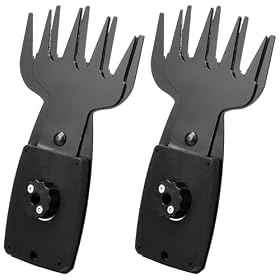 2 Pack 302348001 Hedge Trimmer Grass Shear Blade AssemblyBERPSE
$28.99 as of
View on Amazon
Product prices and availability are accurate as of the date/time indicated and are subject to change. Any price and availability information displayed on Amazon.com at the time of purchase will apply to the purchase of this product.
What tooth spacing and cutting capacity mean
Tooth spacing is the distance between adjacent teeth. Wider spacing can accommodate larger stems, but it does not guarantee that the trimmer can cut every stem that fits between the teeth. The blade shape, motor, and overall design also matter.
Check the manufacturer’s stated maximum cutting capacity and follow its guidance. Hedge growth that is very hard, dry, or tangled may be harder to cut than fresh, flexible growth of a similar thickness.
Maintain blade movement and reduce sticking
 Pruner Lubricant, Hedge Trimmer Oil for Blades, Pruning Shears Oil, 1 fl ozDreyoo
$12.99 as of
View on Amazon Mechanic In A Bottle Blade & Chain Lubricant & Cleaner - 8 oz Bottle (2…Mechanic in a Bottle
$24.10 as of
View on Amazon Supreme Trimmer Hair Clipper & Trimmer Blade Lubricating Oil 4 oz STO710Supreme Trimmer
$5.99 as of
View on Amazon
Product prices and availability are accurate as of the date/time indicated and are subject to change. Any price and availability information displayed on Amazon.com at the time of purchase will apply to the purchase of this product.
Why sharp, clean blades matter
Clean, sharp blades pass through stems more effectively. Sap and debris can make blades drag or stick, while dull or damaged edges can leave ragged cuts and strain the tool. Clean and lubricate the blade as directed in the manual, and inspect it for bent or chipped teeth before use.
Before touching or cleaning the blade, switch the trimmer off and disconnect its power source. Remove the battery or unplug the tool; for a gas model, follow the manufacturer’s instructions to make it safe. Wear gloves when handling the blade.
When a hedge trimmer is the wrong tool
A hedge trimmer is intended for shaping and maintaining hedges, not for cutting large branches or making precision pruning cuts. If stems exceed the stated cutting capacity, use an appropriately sized hand tool or consult a qualified professional for large or hard-to-reach growth.
If the trimmer struggles with growth well within its rated capacity, stop and check for a dirty or damaged blade, a jam, or an incorrectly fitted part. Use only compatible replacement blades. If the blade is bent, badly chipped, or cannot be made to cut properly after the maintenance described in the manual, replace it or have the tool serviced.
FAQ
Do both blades on a hedge trimmer move?
It depends on the design. Some hedge trimmers move two blades in opposite directions; others move one blade against a stationary blade. Both designs shear stems as the blade edges pass one another.
Does wider tooth spacing mean a hedge trimmer can cut thicker branches?
Not by itself. Tooth spacing affects what can fit between the teeth, but the manufacturer’s stated cutting capacity is the better guide to the stem thickness the tool is designed to cut.
Why is my hedge trimmer crushing or tearing stems instead of cutting them cleanly?
The blade may be dull, dirty, damaged, or jammed, or the stems may be beyond the trimmer’s capacity. Disconnect the power source before inspecting or cleaning the blade, and follow the manual’s maintenance instructions.