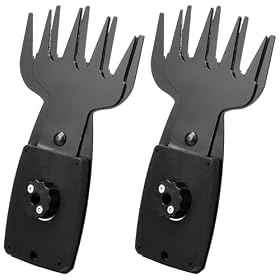
Single-sided blades favor control and predictable cutting, while dual-sided blades can make shaping and directional cutting faster. The better choice depends on hedge size, working position, and your experience—not blade style alone.
What do you need help with?
Open an answer, or tell us what we should cover next.
Answered in this guide
Choose between single-sided and dual-sided hedge trimmer blades
Choose single-sided blades for controlled, directional trimming near obstacles, or dual-sided blades for faster movement across broad hedge faces and around corners. The right choice also depends on hedge size, working position, and experience.
Understand which hedge trimmer blade style is safer
Neither blade style is automatically safe. Single-sided blades can help keep one cutting edge away from obstacles, but both styles still require careful handling because their exposed teeth can cause serious injury.
Look beyond single- or dual-sided construction by checking tooth spacing, cutting capacity, blade length, power source, balance, and vibration. These specifications can affect whether the trimmer suits the hedge and feels manageable during use.
Check whether replacement blade types are interchangeable
Do not assume a single-sided blade can replace a dual-sided blade, or vice versa. Matching mounting holes, drive connections, guards, spacing, and the manufacturer’s compatibility requirements is necessary before attempting a replacement.
Request a topic and help us choose what to build next.
Use hand shears instead of a powered hedge trimmer
Choose a tool for thick or dead hedge branches
Decide whether to hire help for a tall hedge
Requests help us prioritize the next guide. No email required.
One anonymous request per topic.
Single-sided versus dual-sided blades
Single-sided hedge trimmer blades are usually the better choice when you want predictable cutting, easier control, and a narrower cutting path. Dual-sided blades are often more maneuverable for shaping and can cut in either direction, which may make larger or more complex hedges faster to trim. Tooth spacing, blade length, power source, and the hedge’s branch thickness still matter just as much as the blade layout.
What is the difference?
The terms describe where the cutting teeth are positioned along the blade.
Single-sided blades have cutting teeth along one edge, with the other side acting as a guard or non-cutting edge.
Dual-sided blades have cutting teeth along both edges and can cut when moving the trimmer in either direction.
This distinction affects handling and cutting technique. It does not, by itself, determine how thick a branch the trimmer can cut. Always follow the manufacturer’s stated cutting capacity and instructions for the specific hedge trimmer.
Single-sided blades: control and directional cutting
Single-sided blades are commonly chosen for straight, controlled trimming. Because only one edge cuts, you can keep the non-cutting side oriented toward areas you want to protect, such as a fence, wall, or nearby garden bed.
Advantages
More predictable cutting direction: The working edge is clearly defined.
Good control for flat hedge faces: They suit careful, straight passes along the side or top of a hedge.
Reduced risk of contacting objects on the non-cutting side: The inactive edge can face a fence or other obstacle, although it is not a substitute for maintaining a safe clearance.
Useful for newer users: The cutting action may feel easier to manage when you are learning the correct angle and pass direction.
Limitations
Less flexible for changes in direction: You may need to reposition the tool rather than simply reverse your cutting pass.
Potentially slower for detailed shaping: Curves, corners, and irregular growth can require more deliberate movements.
Blade orientation matters: Holding the trimmer at the wrong angle can make it awkward to reach the intended face of the hedge.
Single-sided blades are a sensible fit for formal hedges, narrow working areas, and jobs where controlled passes matter more than rapid movement.
Product prices and availability are accurate as of the date/time indicated and are subject to change. Any price and availability information displayed on Amazon.com at the time of purchase will apply to the purchase of this product.
Dual-sided blades: speed and maneuverability
Dual-sided blades cut on both edges. This allows the trimmer to work while moving left or right, which can be useful when shaping broad hedge faces or changing direction around corners.
Advantages
Faster directional changes: You can make a cutting pass in either direction without turning the tool around.
Better for shaping: Cutting around curves, corners, and uneven growth can be more convenient.
Efficient for larger hedge faces: Repeated back-and-forth passes may cover an area quickly.
More versatile handling: The blade can be repositioned without being limited to one active edge.
Limitations
Requires more awareness near obstacles: Both edges are cutting edges, so extra care is needed around fences, walls, posts, and the ground.
Can feel less forgiving for inexperienced users: An unintended contact or poorly controlled movement may engage the opposite cutting edge.
More important to maintain a stable grip and stance: Avoid twisting the tool or reaching beyond a comfortable position.
Dual-sided blades are often a good match for experienced users, larger hedges, and shaping work where maneuverability is valuable.
Product prices and availability are accurate as of the date/time indicated and are subject to change. Any price and availability information displayed on Amazon.com at the time of purchase will apply to the purchase of this product.
Which blade type is safer?
Neither blade style is automatically safe. Single-sided blades can make it easier to keep one edge away from an obstacle, but the exposed cutting edge still presents a serious injury hazard. Dual-sided blades require awareness of both cutting edges and the direction of every movement.
For either type:
Read the hedge trimmer’s manual before use.
Wear eye protection, substantial footwear, and hearing protection when appropriate.
Keep both hands on the tool if the manufacturer requires it.
Keep people and pets away from the work area.
Turn the trimmer off, disconnect the battery or power source, and wait for the blades to stop before clearing material or inspecting the blade.
Do not use the blade to cut material beyond the tool’s rated capacity.
Be especially careful near hidden fencing, wires, stones, and irrigation components.
If a powered trimmer has been dropped, bent, or damaged, do not continue using it until the blade and guards have been inspected according to the manufacturer’s instructions. A qualified service professional may be appropriate for damage that is not clearly visible or easily addressed with an approved replacement part.
Product prices and availability are accurate as of the date/time indicated and are subject to change. Any price and availability information displayed on Amazon.com at the time of purchase will apply to the purchase of this product.
Cutting performance depends on more than blade style
Blade layout is only one part of the decision. Check these specifications before choosing a hedge trimmer or replacement blade.
Tooth spacing and cutting capacity
Tooth spacing affects the size of growth the blade is designed to handle. Wider spacing may suit thicker, more established stems, while closer spacing is often better for lighter, finer growth. Do not assume that a longer blade or dual-sided design can safely cut thicker branches.
Use the manufacturer’s stated maximum cutting diameter as the guide. Never force the blade through material that exceeds that limit.
Blade length
A longer blade can cover more hedge surface per pass, but it may also be heavier and harder to control in tight spaces. A shorter blade can be easier to maneuver around corners and small shrubs.
Choose length based on the hedge’s width and shape, not simply the largest available option.
Power source
Corded electric, battery-powered, and gas-powered hedge trimmers can use either blade arrangement. Power source does not determine whether a blade is single-sided or dual-sided.
Instead, consider where you will work, how long the job usually takes, and whether a cord, battery charging, fuel, or engine maintenance is practical. The trimmer must also provide enough power for the hedge growth you intend to cut.
Balance and vibration
A blade that looks suitable on paper may still be uncomfortable if the complete trimmer is front-heavy or produces noticeable vibration. Balance affects how accurately you can hold the cutting angle and how quickly your arms become fatigued.
If possible, compare the tool’s weight, handle position, and control layout with the way you normally trim. For battery models, remember that the installed battery contributes to the operating weight.
Choose single-sided blades if…
A single-sided blade is generally the better fit when:
You prioritize deliberate, straight passes.
You trim close to a fence, wall, or other boundary.
You are less experienced with powered hedge trimmers.
Your hedge has a formal, flat-sided shape.
You prefer a clearly defined cutting edge over rapid direction changes.
Choose dual-sided blades if…
A dual-sided blade is generally the better fit when:
You want to shape curves, corners, or irregular growth.
You trim larger hedge faces and change direction frequently.
You are comfortable controlling both cutting edges.
You value maneuverability and fast back-and-forth passes.
The tool’s weight and vibration remain manageable in your normal working position.
Can you replace one blade type with the other?
Usually, you should not assume that a single-sided and dual-sided blade are interchangeable, even if they appear to have similar dimensions. Blade mounting holes, drive connections, guards, tooth spacing, length, and safety design must all match the hedge trimmer.
Use an approved replacement blade specified for your exact trimmer model. If the manufacturer does not list the alternative blade as compatible, replacing the complete trimmer may be more practical than modifying the tool. Do not drill, grind, bend, or otherwise alter a blade to make it fit.
Maintenance for either blade style
Before maintenance, switch off the trimmer, disconnect its power source, and wait for all movement to stop. Then:
Remove plant debris from the blade.
Inspect for bent teeth, cracks, excessive wear, or damaged guards.
Apply only the lubricant recommended in the owner’s manual.
Store the trimmer with the supplied blade sheath or another manufacturer-approved cover.
Have damaged or severely dull blades serviced or replaced according to the manufacturer’s instructions.
A blade that snags, produces unusual vibration, or leaves torn rather than clean cuts may need cleaning, sharpening by an approved method, professional service, or replacement. Do not keep operating the trimmer to see whether a damaged blade improves.
Bottom line
Choose a single-sided blade for control, defined cutting direction, and careful work near boundaries. Choose a dual-sided blade for easier directional changes, shaping, and efficient back-and-forth trimming. For the final decision, confirm the blade’s compatibility, tooth spacing, length, cutting capacity, and the complete trimmer’s balance. The right blade is the one that matches both the hedge and your ability to control the tool safely.
FAQ
Are single-sided hedge trimmer blades easier to use?
They can be easier to control because only one edge cuts and the working direction is more obvious. They are not automatically safer, however; the active edge still requires careful handling and proper protective equipment.
Are dual-sided hedge trimmer blades faster?
They can make trimming faster when you frequently change direction or shape large, irregular hedges. Actual speed also depends on blade length, tooth spacing, motor power, hedge thickness, and the operator’s technique.
Can I put a dual-sided blade on a single-sided hedge trimmer?
Do not assume they are interchangeable. Use only a blade listed as compatible with the exact hedge trimmer model, because mounting parts, guards, tooth spacing, and blade movement must match.
Which blade is better for trimming near a fence?
A single-sided blade may offer more predictable control because its non-cutting edge can face the fence. Maintain clearance either way, and follow the manufacturer’s safety instructions.